RG-405 cable loss (EZ 86)
EZ 86 loses 2.28 dB per 10 m at 144 MHz (extrapolated) and 10.0 dB at 2.4 GHz. The part is Huber+Suhner EZ_86_TP_M17, and every number here is fitted to the attenuation table on its datasheet. Drag the cursor or type a frequency, length and power to read the loss for your run.
EZ 86 loss for 10.0 m, matched
Fit inside the printed tableExtrapolatedDatasheet rowsBand marks (the cursor snaps to them)
Neighbours at 2.40 GHz
Rank 17 of 24 cables with a number at 2.40 GHz, lowest loss first.
Loss chart
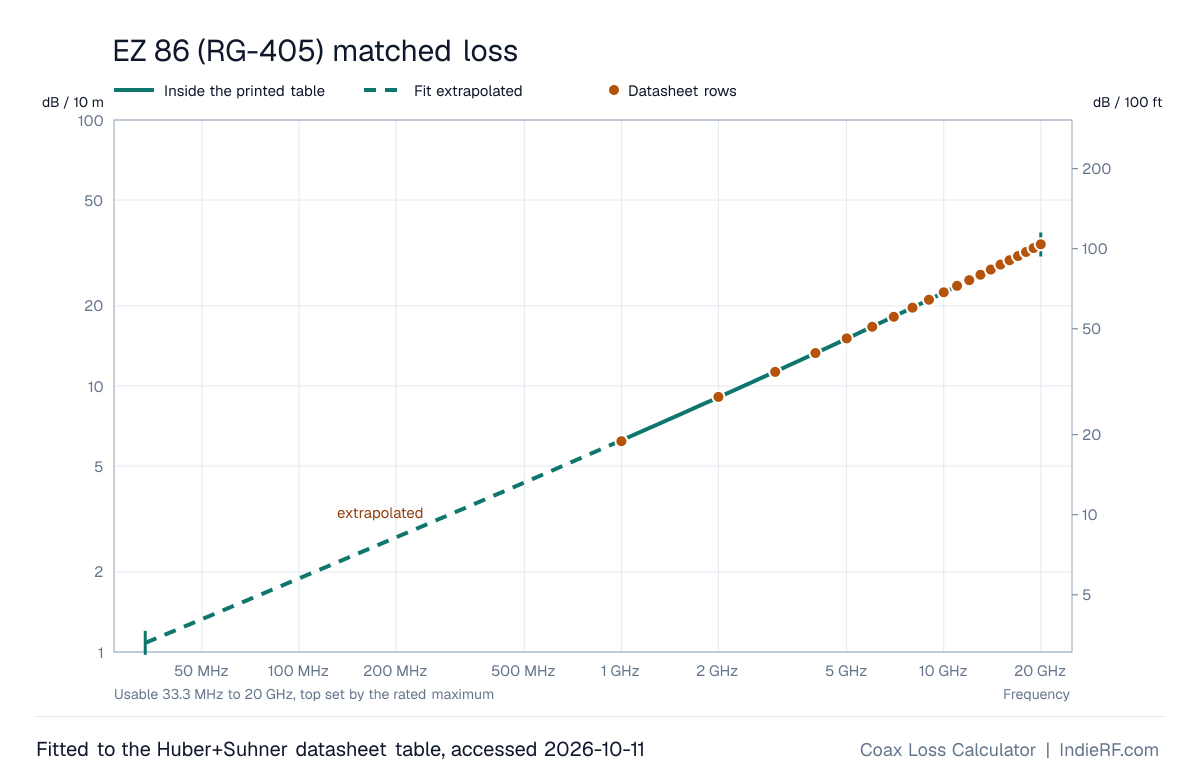
Loss at 144 MHz to 5.8 GHz
| Frequency | dB per 10 m | dB per 100 ft | From |
|---|---|---|---|
| 144 MHz | 2.28 | 6.95 | extrapolated |
| 433 MHz | 4.02 | 12.3 | extrapolated |
| 915 MHz | 5.96 | 18.2 | extrapolated |
| 1.09 GHz | 6.54 | 19.9 | printed |
| 2.4 GHz | 10.0 | 30.5 | printed |
| 5.8 GHz | 16.4 | 49.9 | printed |
Printed means inside the datasheet table. A frequency outside the usable range names the limit instead of a number.
Cross-section
Loss at each band
| Band | dB per 10 m | dB per 100 ft |
|---|---|---|
| 1.8 MHz | Below the usable range, which starts at 33.3 MHz | |
| 3.5 MHz | Below the usable range, which starts at 33.3 MHz | |
| 7 MHz | Below the usable range, which starts at 33.3 MHz | |
| 14 MHz | Below the usable range, which starts at 33.3 MHz | |
| 28 MHz | Below the usable range, which starts at 33.3 MHz | |
| 50 MHz | 1.33 | 4.05extrapolated |
| 144 MHz | 2.28 | 6.95extrapolated |
| 433 MHz | 4.02 | 12.3extrapolated |
| 915 MHz | 5.96 | 18.2extrapolated |
| 1.57 GHz | 7.97 | 24.3 |
| 2.4 GHz | 10.0 | 30.5 |
| 5.8 GHz | 16.4 | 49.9 |
Matched loss from the fit. A band past the printed table is marked extrapolated. A band outside the usable range names the limit instead of a number.
Datasheet table
| MHz | Printed, dB/m | Fit | Fit − printed | Maker formula |
|---|---|---|---|---|
| 1000 | 0.62 | 0.6249 | +0.005 | 0.6242 |
| 2000 | 0.91 | 0.9068 | -0.003 | 0.9060 |
| 3000 | 1.13 | 1.132 | +0.002 | 1.131 |
| 4000 | 1.33 | 1.328 | -0.002 | 1.328 |
| 5000 | 1.51 | 1.506 | -0.004 | 1.505 |
| 6000 | 1.67 | 1.670 | +0.000 | 1.670 |
| 7000 | 1.82 | 1.825 | +0.005 | 1.824 |
| 8000 | 1.97 | 1.971 | +0.001 | 1.971 |
| 9000 | 2.11 | 2.111 | +0.001 | 2.111 |
| 10000 | 2.25 | 2.245 | -0.005 | 2.245 |
| 11000 | 2.38 | 2.375 | -0.005 | 2.375 |
| 12000 | 2.5 | 2.501 | +0.001 | 2.501 |
| 13000 | 2.62 | 2.623 | +0.003 | 2.623 |
| 14000 | 2.74 | 2.742 | +0.002 | 2.743 |
| 15000 | 2.86 | 2.858 | -0.002 | 2.859 |
| 16000 | 2.97 | 2.972 | +0.002 | 2.973 |
| 17000 | 3.08 | 3.083 | +0.003 | 3.085 |
| 18000 | 3.19 | 3.193 | +0.003 | 3.194 |
| 19000 | 3.3 | 3.300 | -0.000 | 3.302 |
| 20000 | 3.41 | 3.406 | -0.004 | 3.408 |
Huber+Suhner EZ_86_TP_M17 data sheet, DOC-0000177968 Rev. F, accessed 2026-10-11. Huber+Suhner EZ_86_TP_M17.
α (dB/m) = a·√f + b·f with f in GHz: a = 0.5855, b = 0.03935. Least squares over the 20 printed rows. RMS miss 0.003 dB/m, largest 0.005 dB/m at 11.0 GHz.
The sheet's own formula: dB/m = 0.58454·√f + 0.03967·f with f in GHz.
Usable range and build
Printed from 1 GHz to 20 GHz. Usable from 33.3 MHz to 20 GHz; the top is set by the rated maximum. TE11 cutoff 60.6 GHz, from the printed diameters and velocity factor.
- Maker
- Huber+Suhner
- RG name on the sheet
- RG-405
- Impedance
- 50 Ω
- Velocity factor
- 0.695
- Delay
- 4.80 ns/m
- Dielectric
- PTFE
- Centre conductor
- 0.51 mm
- Dielectric diameter
- 1.68 mm
- Outer conductor
- 2.2 mm
- Rated maximum
- 20.0 GHz
- Printed cutoff
- not printed
- Weight
- 2.35 kg/100 m
- Bend radius, installed
- 3.18 mm
- Bend radius, repeated
- not printed
- Shield
- Solid tin-plated copper tube
- RG-405 is the 0.086 in semi-rigid size. This sheet's outer conductor is 2.2 mm and its attenuation table stops at 20 GHz, which is also the printed maximum operating frequency on Rev. F.
Compare all cablesEvery cable's fit as CSV (CC BY 4.0)Question about this cable, or a correction?