Link budget / MDS / EIRP · coming soon
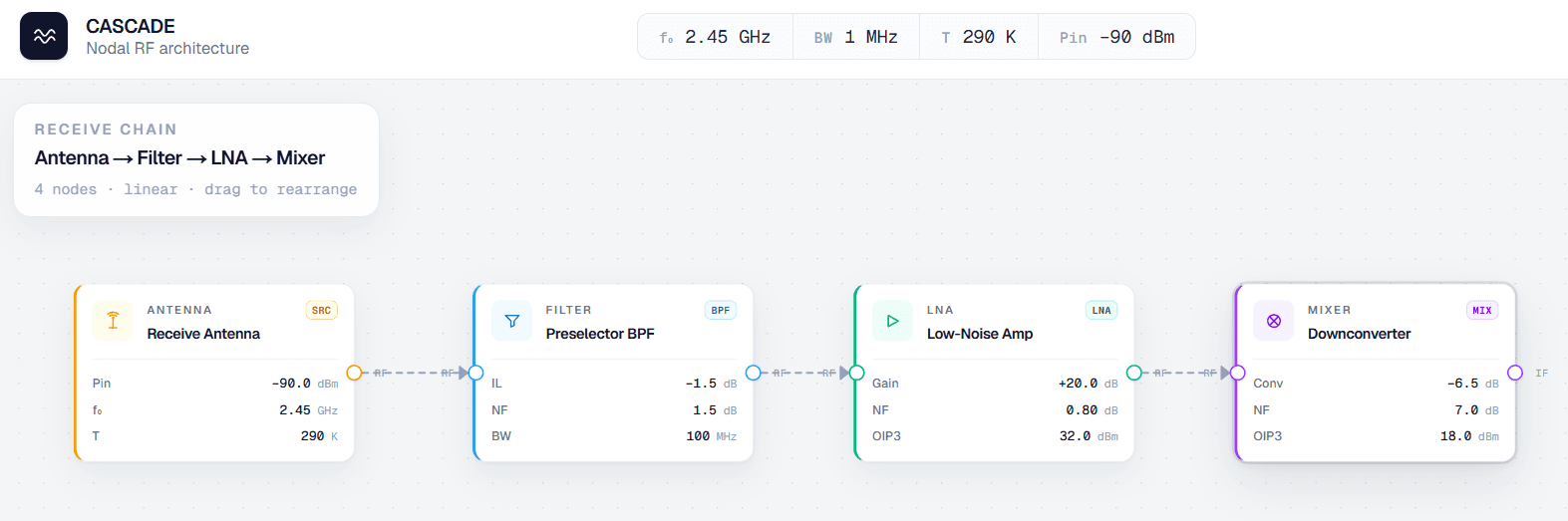
Coming soon. Free-space path loss is not a live calculator yet. A receive chain can already take antenna power, noise, and bandwidth in the cascade tool.
Free RF engineering tools
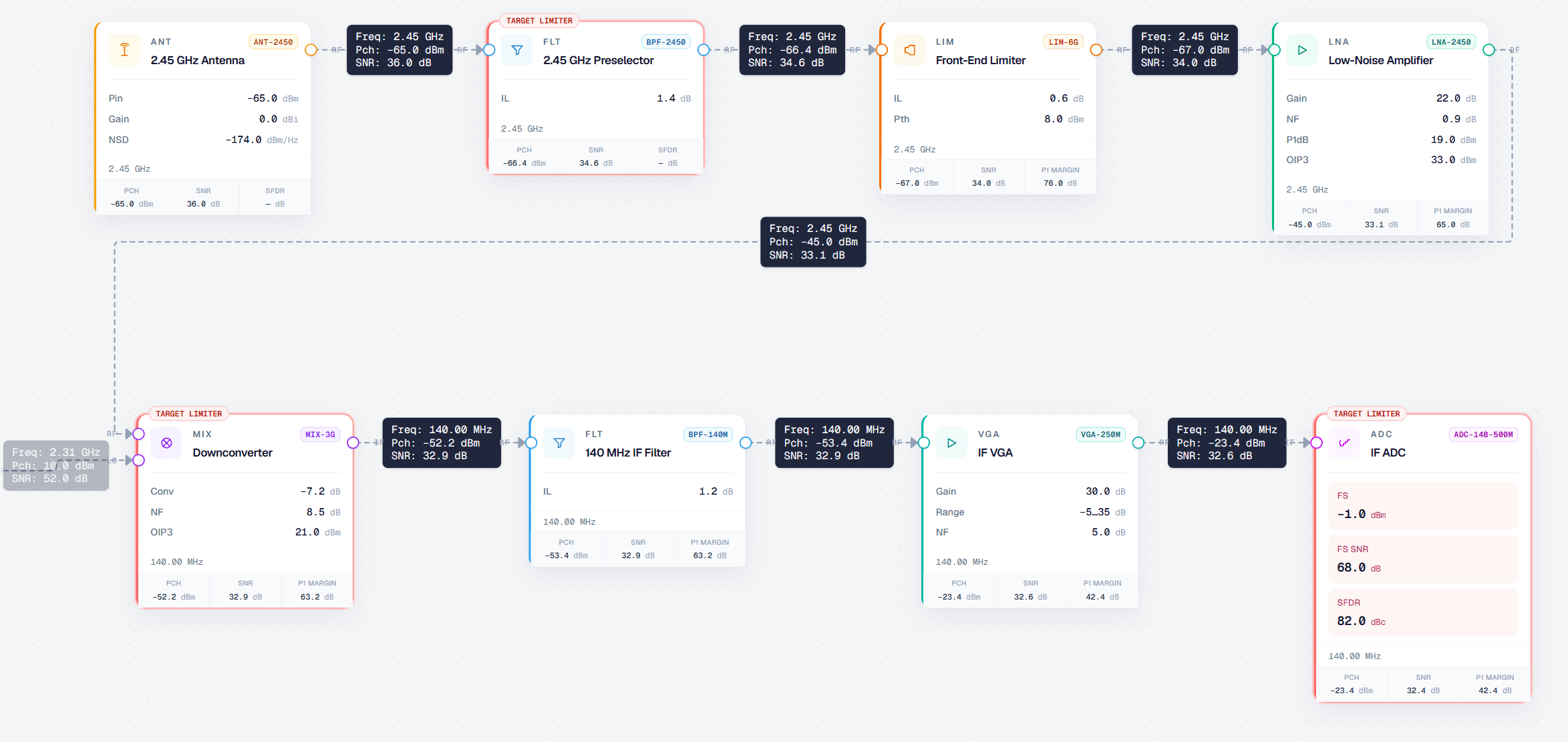
Drag stages onto a canvas and read NF, IP3, P1dB and SFDR at every node, including splits and combiners a spreadsheet can't follow. Free in the browser, checked against hand math. Every design is a link you can share.
Use every tool online for free. Exports are free, no account needed. Sign in to save a project to the cloud and to post in discussions. Unsigned sessions still autosave in this browser so a refresh does not wipe the canvas.
On the bench now
Live · free
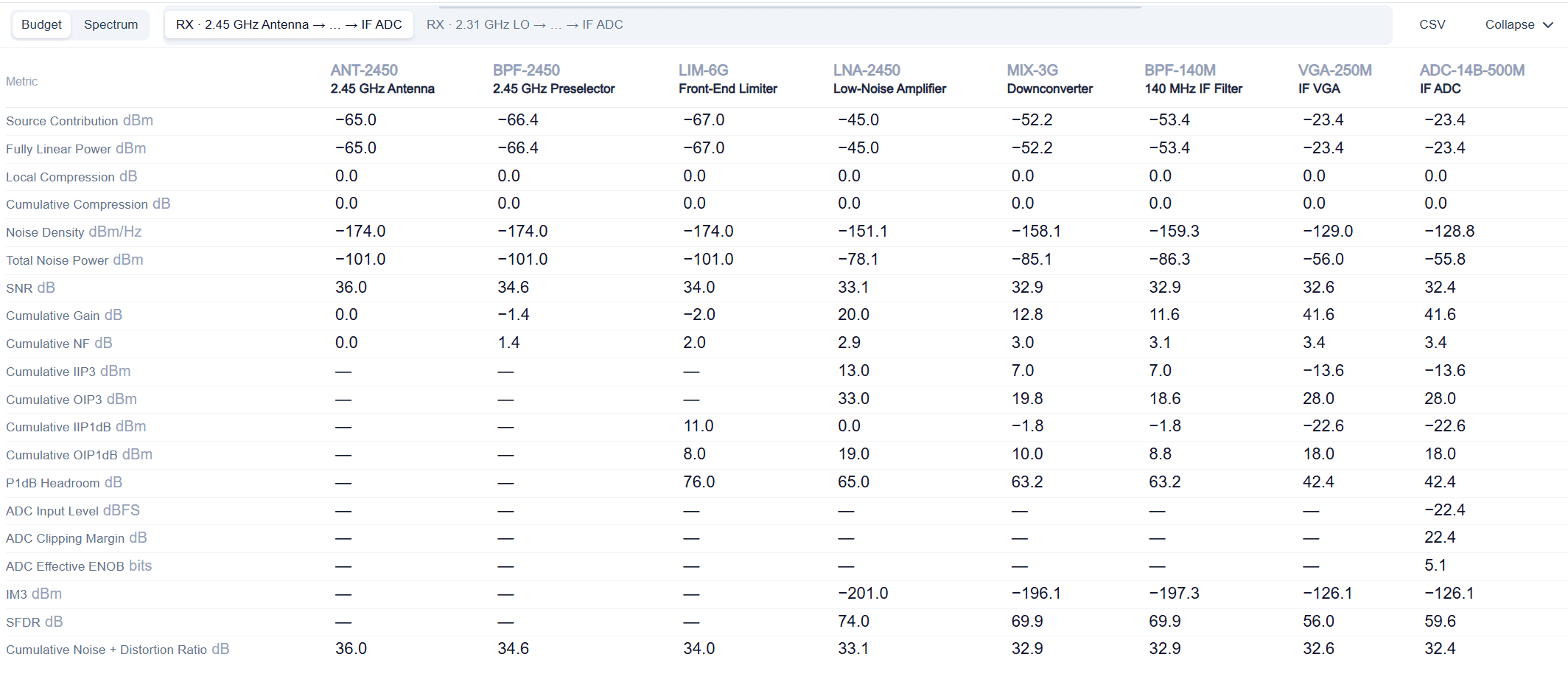
Draw a receive or transmit chain, then read Gain, Friis NF, P1dB, OIP3/IIP3, IM3, and SFDR at every node. Path-aware budgets, A/B captures, and named templates — without a $50k license or a fragile spreadsheet.
Live · free
Convert dBm ↔ watts ↔ milliwatts ↔ 50 Ω volts, apply 10log vs 20log without mixing them up, and read the kTB noise floor from bandwidth. The 1-2-3-7-10 shortcuts, in a page you can keep open next to the spectrum analyzer.
Live · free
Size a 50 Ω microstrip, stripline, GCPW, or CPW, or an edge-coupled differential pair at 90 Ω USB, 100 Ω Ethernet or LVDS, or 85 Ω PCIe. Compare insertion loss across Rogers, FR-4, alumina, GaAs, and common finishes — ENIG, ENEPIG, OSP, immersion silver, immersion tin, or gold chip-and-wire. Lock the width to the target and see conductor, dielectric, roughness, and mask loss separately.
Live · free
Read matched loss, the extra loss from a mismatched load, power at the load, and delay for RG-58, RG-174, RG-316, LMR-400, and semi-rigid. Each attenuation table is one manufacturer datasheet, fit as a·√f + b·f, and left blank past the last printed frequency.
Live · free
Type VSWR, return loss, |S11| in dB, |Γ|, mismatch loss, or reflected power and read the other five. VSWR 2 is 9.54 dB return loss and 0.51 dB of mismatch loss. A printable VSWR 1.01 to 10 table and its CSV are free.
Live · free
Type the loss and the impedance at each end, and read pi, T, bridged-T or minimum-loss pad resistors, the nearest E24 and E96 parts, and the loss and return loss those parts give. A 50 Ω 3 dB pi is 292.4 Ω and 17.6 Ω. The 1 to 30 dB table at 50 Ω and 75 Ω prints and downloads as a CSV for free.
Live · free
Type the RF band, the IF band and the LO side, and see every m x n product and input spur to order 15 on one chart, with the ones that land in your IF flagged. RF 1500 to 1700 MHz into a 490 to 690 MHz IF puts |RF − 2LO| at 320 to 520 MHz, inside the IF. Paste the datasheet spur table to add levels.
Live · free
Type or paste a phase noise mask, set the carrier and the integration band, and read rms jitter, rms phase error and the ADC SNR limit. A 100 MHz clock with a −150 dBc/Hz floor has 344 fs rms jitter from 12 kHz to 20 MHz, which caps a 70 MHz ADC input at 76.4 dB SNR.
Live · free
Type transmit power, antenna gains, cable loss, frequency, and distance, and read free-space path loss, received power, margin, and range. LoRa presets use the Semtech SX1262 datasheet sensitivities. A US check compares conducted power with the 47 CFR 15.247 limits.
Live · free
Drop an .s2p and read K, μ and μ′ at every point, then the load and source stability circles at any frequency with the stable side shaded. The synthetic FET example is unconditionally stable only from 8.68 to 15.1 GHz.
Live · free
Drop an .s2p and drag Γ_S and Γ_L on two Smith charts. Gain, noise and stability circles, G_T, G_P, G_A, NF and VSWR all follow, and Match builds the networks. At 10 GHz the synthetic FET example reaches 12.26 dB, or 0.88 dB NF at 10.78 dB of gain.
Live · free
Short, reference-plane-honest writeups on cascade math, traces, and the limits of the models. Built next to the workbench, not as a marketing blog. Sign in to post in the discussion.
Live · free
Drop a .s2p / .s1p and get log-mag, phase, VSWR, and group delay without opening a VNA suite. Overlay parts, compare vendor files, and keep the same reference-plane honesty as RF Cascade Analyzer.
Live · free
Click a datasheet NF, P1dB, or IP3 vs-frequency curve and land a dataset RF Cascade Analyzer can interpolate. The missing link between a PDF graph and a frequency-dependent cascade.
Live · free
Type a load or drop a 1–4 port Touchstone file and read the L-network on a Smith chart. Parts snap to an RF grid, component Q is optional, and the matched return loss stays on screen. Share links, Touchstone files, and the BOM download without an account.
Live · free
Draw an RF circuit, import a Touchstone file, and read S-parameters on a Smith chart and rectangular plots. Lines, microstrip, and ideal parts solve in your browser, with sliders to tune values. Copy a link, download the file, or save to the cloud when you sign in.
Live · free
Turn 0 to 2.5 V in into −3.0 to −1.5 V out: the rescaler wizard picks 20 k, 7.5 k, 12 k and 10 k on E24 with 0 V error at both ends, where the wizard's second choice is 6.6 mV off. The gain and offset readout then gives m = 0.6 V/V and b = −3 V, and the 22 ppm that A0 = 1e5 costs. Ten templates solve on open with a DC sweep and a Bode plot. Free, with no account.
Live · free
Draw a microstrip layout in a shielded box and solve it to S-parameters in your browser: 2,500 unknowns take about 30 s for 11 frequencies, and past that Run shows the time and memory first and saves as it goes. Cross-check a Transmission Line Calculator line, turn a step, gap, bend, or tee into a Touchstone file, or size a stub. Metal is a zero-thickness sheet in a closed box. Free, with no account.
IndieRF RF Cascade Analyzer
Independent RX and TX paths, splitters, combiners, and path-aware budgets. The file downloads without an account.
Search cases this suite answers
RF cascade / Friis NF
Cumulative gain, Friis NF, P1dB headroom, OIP3/IIP3, IM3, and SFDR along a real source-to-sink path — not a row of cells that drift when you insert a filter.
dBm ↔ W ↔ V into 50 Ω
10log vs 20log, kTB from bandwidth, and the conversions you still do on a whiteboard during a design review.
50 Ω microstrip / GCPW loss
Width for 50 Ω, then insertion loss with ENIG, ENEPIG, OSP, or gold chip-and-wire — the finish delta datasheets rarely put in one table.
Smith chart / L-network match
Type a load or drop a Touchstone file, then read the L-section on a Smith chart with real part values and the matched return-loss band.
S-parameter / Touchstone plot
Drop .s2p files, overlay units, and read log-mag, phase, VSWR, and group delay with markers — without opening a VNA suite.
Link budget / MDS / EIRP · coming soon
Coming soon. Free-space path loss is not a live calculator yet. A receive chain can already take antenna power, noise, and bandwidth in the cascade tool.
Why not Excel — and not a $50k suite
01
Friis NF, reciprocal IP3, cascaded P1dB, and IM3 with hand-checked regressions. No accidental cell offsets.
02
Drag RF blocks with typed ports. Independent paths, splitters, and combiners. Signal, noise, and headroom at the node you clicked.
03
Matched scalar cascade at the operating point. Not a general S-parameter, mismatch, or waveform solver — those are separate tools on the roadmap.
Building next
iFFT TDR is next. Plot Digitizer and S-parameter Viewer are live as their own tools so RF Cascade Analyzer does not pretend to be a VNA, an EM solver, or a graph digitizer.
Building next
Turn a one-port S11 into a time-domain reflectometry trace. Windowing, rise-time, dielectric, and distance-to-fault — the VNA option most benches cannot justify, as a free browser tool with the caveats labeled.
On the roadmap
PLL loop filter & phase noise estimator
FAQ
Optional updates
Saving work and posting in discussions already uses a free account. This list is only for shipping news — not a waitlist for access.