LMR-195 cable loss
LMR-195 loses 1.42 dB per 10 m at 144 MHz and 6.10 dB at 2.4 GHz. The part is Times Microwave LMR-195, and every number here is fitted to the attenuation table on its datasheet. Drag the cursor or type a frequency, length and power to read the loss for your run.
LMR-195 loss for 10.0 m, matched
Fit inside the printed tableExtrapolatedDatasheet rowsBand marks (the cursor snaps to them)
Neighbours at 2.40 GHz
Rank 13 of 24 cables with a number at 2.40 GHz, lowest loss first.
Loss chart
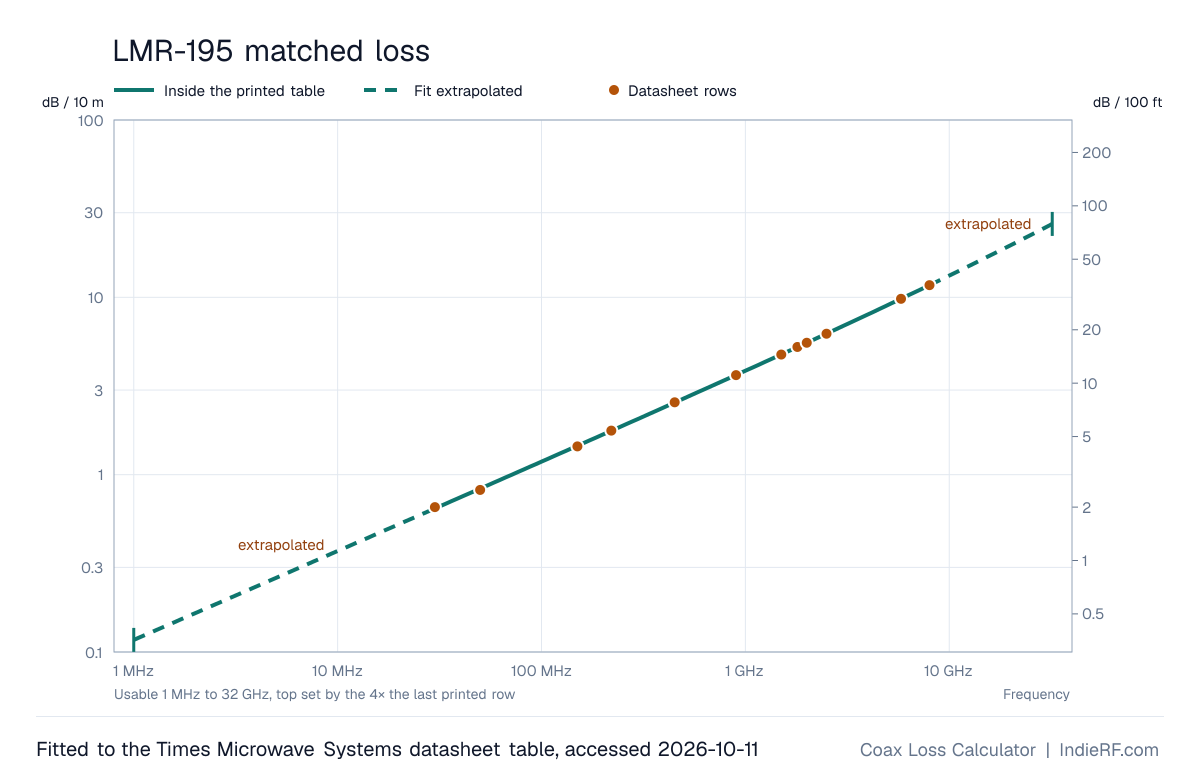
Loss at 144 MHz to 5.8 GHz
| Frequency | dB per 10 m | dB per 100 ft | From |
|---|---|---|---|
| 144 MHz | 1.42 | 4.34 | printed |
| 433 MHz | 2.50 | 7.62 | printed |
| 915 MHz | 3.68 | 11.2 | printed |
| 1.09 GHz | 4.03 | 12.3 | printed |
| 2.4 GHz | 6.10 | 18.6 | printed |
| 5.8 GHz | 9.81 | 29.9 | printed |
Printed means inside the datasheet table. A frequency outside the usable range names the limit instead of a number.
Cross-section
Loss at each band
| Band | dB per 10 m | dB per 100 ft |
|---|---|---|
| 1.8 MHz | 0.16 | 0.48extrapolated |
| 3.5 MHz | 0.22 | 0.67extrapolated |
| 7 MHz | 0.31 | 0.95extrapolated |
| 14 MHz | 0.44 | 1.34extrapolated |
| 28 MHz | 0.62 | 1.90extrapolated |
| 50 MHz | 0.83 | 2.54 |
| 144 MHz | 1.42 | 4.34 |
| 433 MHz | 2.50 | 7.62 |
| 915 MHz | 3.68 | 11.2 |
| 1.57 GHz | 4.89 | 14.9 |
| 2.4 GHz | 6.10 | 18.6 |
| 5.8 GHz | 9.81 | 29.9 |
Matched loss from the fit. A band past the printed table is marked extrapolated. A band outside the usable range names the limit instead of a number.
Datasheet table
| MHz | Printed, dB/100 ft | Fit | Fit − printed | Maker formula |
|---|---|---|---|---|
| 30 | 2 | 1.965 | -0.035 | 1.969 |
| 50 | 2.5 | 2.543 | +0.043 | 2.547 |
| 150 | 4.4 | 4.434 | +0.034 | 4.441 |
| 220 | 5.4 | 5.389 | -0.011 | 5.396 |
| 450 | 7.8 | 7.772 | -0.028 | 7.782 |
| 900 | 11.1 | 11.12 | +0.017 | 11.13 |
| 1500 | 14.5 | 14.51 | +0.015 | 14.53 |
| 1800 | 16 | 15.98 | -0.025 | 15.99 |
| 2000 | 16.9 | 16.89 | -0.012 | 16.90 |
| 2500 | 19 | 19.01 | +0.009 | 19.02 |
| 5800 | 29.9 | 29.91 | +0.009 | 29.90 |
| 8000 | 35.7 | 35.70 | -0.004 | 35.68 |
Times Microwave LMR-195 datasheet, accessed 2026-10-11. Times Microwave LMR-195.
α (dB/m) = a·√f + b·f with f in GHz: a = 0.3695, b = 0.01574. Least squares over the 12 printed rows. RMS miss 0.023 dB/100 ft, largest 0.043 dB/100 ft at 50.0 MHz.
The sheet's own formula: dB/100 ft = 0.356859·√f + 0.00047·f with f in MHz.
Usable range and build
Printed from 30 MHz to 8 GHz. Usable from 1 MHz to 32 GHz; the top is set by the 4× the last printed row. TE11 cutoff 40.9 GHz, from the printed diameters and velocity factor.
- Maker
- Times Microwave Systems
- Impedance
- 50 Ω
- Velocity factor
- 0.8
- Delay
- 4.17 ns/m
- Dielectric
- foam polyethylene
- Centre conductor
- 0.037 in (0.94 mm)
- Dielectric diameter
- 0.11 in (2.79 mm)
- Jacket OD
- 4.95 mm
- Rated maximum
- not printed
- Printed cutoff
- not printed
- Weight
- 0.021 lb/ft
- Bend radius, installed
- 0.5 in (12.7 mm)
- Bend radius, repeated
- 2 in (50.8 mm)
- Shield
- Aluminum tape plus tinned copper braid
- Attenuation table and formula run through 8000 MHz. The Times sheet prints no maximum operating frequency. Fairview's reprint lists DC–8 GHz, which is not used as a rating here.
Compare all cablesEvery cable's fit as CSV (CC BY 4.0)Question about this cable, or a correction?